Backend

Designing Modern Backend Systems with Spring Boot Microservices: A Practical Guide

Nayeem Khan
March 20, 2024
12 min read
Spring BootMicroservicesJavaSpring CloudEurekaAPI GatewayResilience4j
Designing Modern Backend Systems with Spring Boot Microservices: A Practical Guide

In today’s software architecture landscape, organizations are increasingly adopting microservices to replace the limitations of monolithic applications. Microservices architecture is a method of developing software systems as a suite of small, independently deployable, loosely coupled services organized around business capabilities.

Why Microservices?

Microservices offer significant advantages over traditional monolithic systems. By decomposing applications into multiple services, each focused on a specific feature or functionality, teams can develop, deploy, and scale different parts of an application independently. This leads to greater agility, improved fault tolerance, and better alignment with modern DevOps practices.

Key Characteristics of Microservices Architecture

  • Decentralized Data Management: Each service typically manages its own database to prevent tight coupling.
  • Independent Deployability: Teams can deploy updates to one service without affecting the entire system.
  • Resilience and Fault Isolation: Failures in one service should not cascade throughout the system.
  • Technology Diversity: Services can be built with different programming languages and frameworks suited to their requirements.
  • Role of Spring Boot in Microservices

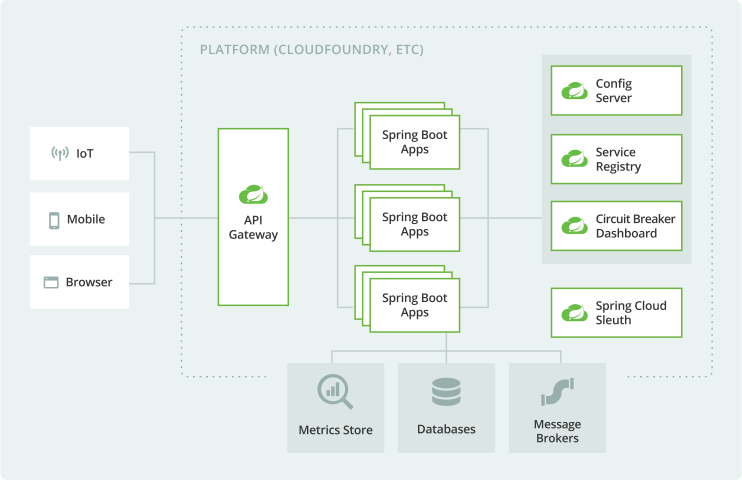
    Spring Boot is widely popular for building microservices due to its minimal configuration, production-ready features, and seamless integration with Spring Cloud tools. It simplifies application bootstrapping and enables developers to quickly set up services with embedded servers and essential dependencies.

    Key Components in a Spring Boot Microservices System

  • Service Discovery: Automatically registers services and helps other services locate them without hardcoding network locations.
  • API Gateway: Acts as a single entry point for client requests, handling routing, load balancing, and security.
  • Centralized Configuration: Externalizes service configuration so changes can be made without rebuilding applications.
  • Resilience Patterns: Implements circuit breakers, retries, and fallbacks to improve system robustness.
  • Distributed Tracing: Tracks requests across multiple services to monitor performance and identify issues.
  • Microservices Deployment Considerations

    To operate microservices effectively in production, it’s essential to implement:

  • Containerization: Package services in lightweight, isolated containers for consistent deployment across environments.
  • Orchestration: Use tools like Kubernetes to manage containerized applications and handle scaling, failover, and updates.
  • Centralized Logging and Monitoring: Aggregate logs and metrics to monitor system health and performance.
  • Security Management: Secure service communication using OAuth2, JWT tokens, or mutual TLS.
  • Best Practices for Designing Microservices

  • Keep services small, focusing on a single business capability.
  • Define clear API contracts for inter-service communication.
  • Avoid shared databases to maintain service autonomy.
  • Ensure services are stateless for better scalability.
  • Use asynchronous messaging where appropriate to decouple services.
  • Conclusion

    Building scalable microservices with Spring Boot offers organizations a flexible, resilient, and future-ready approach to software development. By leveraging Spring Boot’s ease of use and Spring Cloud’s powerful distributed system tools, teams can confidently architect systems that align with modern operational models, support continuous delivery, and scale effortlessly with business growth.
    NK

    Nayeem Khan

    Full Stack Developer & Technical Writer

    Related Articles